 Tsunamis are waves with very long wavelengths, typically hundreds of kilometres.
Tsunamis are caused by the sudden movement of the ocean surface due to earthquakes,
landslides, volcanic eruptions or meteorite impacts on the land or sea floor.
Tsunamis are waves with very long wavelengths, typically hundreds of kilometres.
Tsunamis are caused by the sudden movement of the ocean surface due to earthquakes,
landslides, volcanic eruptions or meteorite impacts on the land or sea floor.
Types of tsunamis
Land-threat tsunamis cause dangerous inundation (flooding) and structural damage of low-lying coastal areas as well as dangerous ocean currents.
Marine-threat tsunamis are not expected to cause widespread land inundation, but will likely generate dangerous currents, abnormal tides, strong waves and cause coastal erosion. They may result in localised overflow onto the immediate foreshore.
Past events
Land-threat tsunami
- Followed eruption of Hunga Tonga-Hunga Ha-api submarine volcano
- Waves travelled 3000km
- Beaches were closed, however no damage recorded in NSW
Marine-threat tsunamis
- Seven tsunamis since 2007
- Tsunamis that have impacted the NSW coast over the last 20 years were caused by earthquakes in the Solomon Islands (2007), Puysegur (2009), Chile (2010), Japan (2011), Kermadec (2021) and New Hebrides (2021 and 2023).
Tsunami evacuation areas
These maps show the evacuation areas in the event of a tsunami. Anyone living or working in these areas would have to move to higher ground, at least 10 meters above sea level or 1 km away from the coast or rivers.
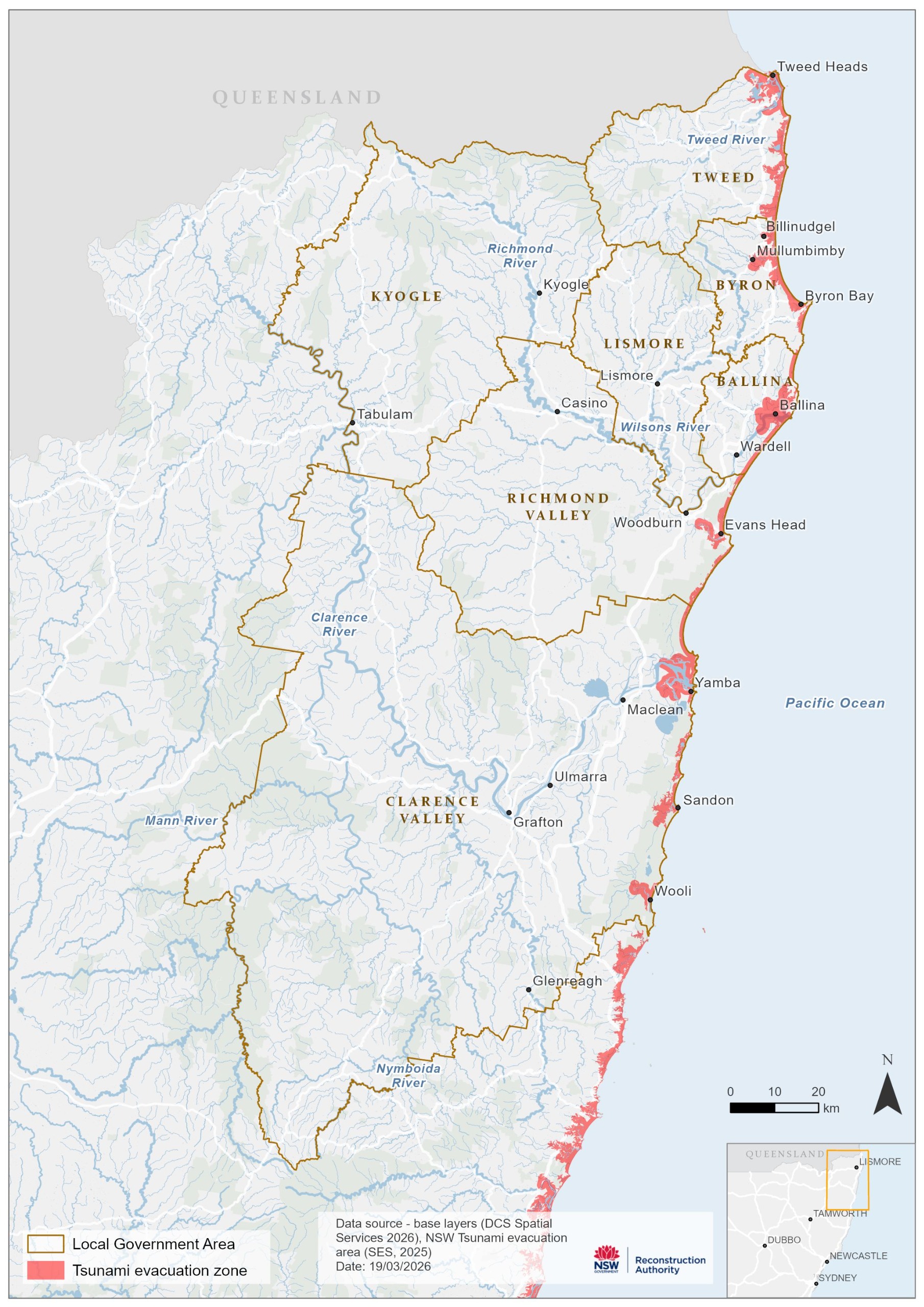
Source: State Tsunami Plan, NSW State Emergency Service, 2023
Current and future risk
Tsunamis are a low probability event along the Northern Rivers coastline. While recorded tsunamis along the NSW coast have resulted in only minor damage, the possibility of a significant event remains.
Next steps
Note: The information contained on these Have Your Say website pages is general information only, based on knowledge and understanding at the time of publication (June 2026) or otherwise based on data which pre-dates its publication, and may be subject to change at any time without notice. The State of NSW and its agencies (including the NSW Reconstruction Authority) do not give any warranty or representation as to the accuracy, reliability or completeness of the information. Read our full legal notice at bottom of the Have Your Say landing page.