 A cyclone is a powerful, rapidly rotating storm that forms over warm tropical oceans.
In other parts of the world, these storms are called hurricanes or typhoons.
A cyclone is a powerful, rapidly rotating storm that forms over warm tropical oceans.
In other parts of the world, these storms are called hurricanes or typhoons.
Tropical cyclones
In Australia, a tropical cyclone forms over tropical waters, such as the Coral Sea, however tropical cyclones can travel southwards and impact northern NSW. If it weakens as it moves over land or cooler water, it is considered an ex-tropical cyclone, but can still bring significant impacts.
Recent event: Ex-Tropical Cyclone Alfred, March 2025
- Caused significant damage, severe coastal erosion and major flooding in the Richmond and Clarence Rivers.
- Wind gusts over 120 km/h at Byron Bay and 100 km/h at Evans Head were recorded.
- Widespread power outages to over 43,000 homes and over 120 schools were closed.
- NSW SES received 13,969 requests for assistance and responded to 7,650 incidents.
Pathway of Tropical Cyclone Alfred
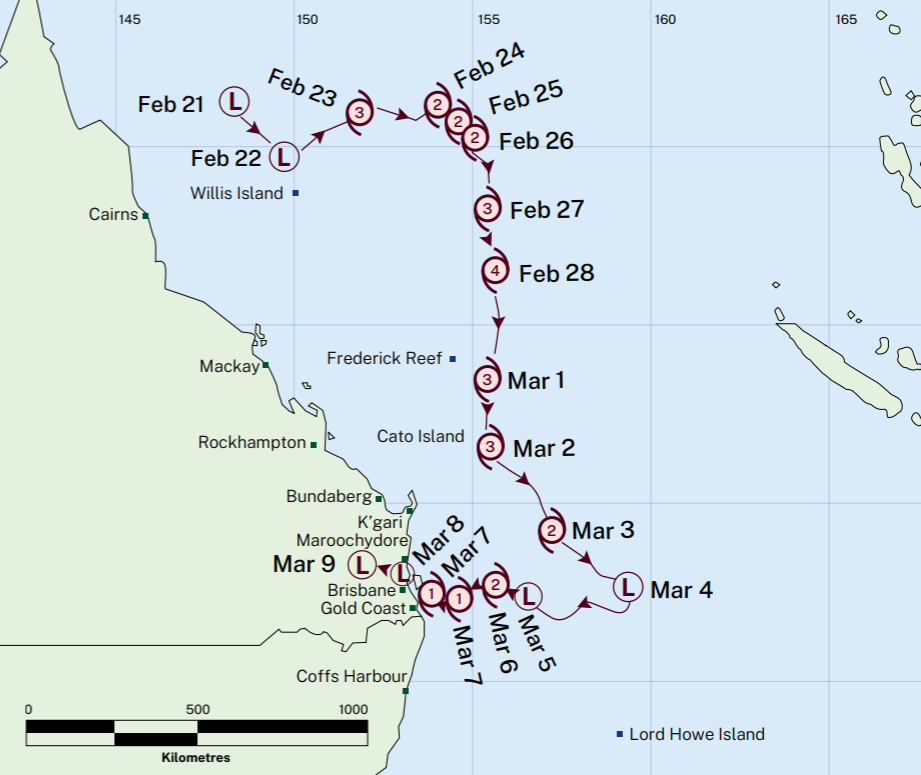
Source: Bureau of Meteorology, 2025 - Illustration redrawn from original image.
Cyclone Alfred was a long-lived and erratic tropical cyclone that travelled south off the coast of Queensland before making landfall as an ex-tropical cyclone. The cyclone icon on the graphic shows its strength (can range from 1 to 5, with 5 being the strongest), and also when it lost strength and become a tropical low (L).
Current risk
- Across Australia, the number of tropical cyclones has decreased by about 10% over the past 40 years.
- Tropical cyclones are relatively rare in the Northern Rivers, but when they do occur, they can cause widespread and severe damage.
Future risk
- Climate projections suggest that the number of tropical cyclones along Australia’s east coast is likely to reduce by about 4-15%.
- Some global projections indicate that while cyclones may become less frequent, a greater proportion could be more intense, with heavier rainfall and higher storm surges. It is unclear whether these trends will occur in Australia.
- Based on what we know right now, tropical cyclone risk in the Northern Rivers is likely to decrease due to climate change, but may increase over time as the population grows.
- There is still a high level of uncertainty around how tropical cyclones in Australia may change in the future, and more research is needed.
Impacts

|
Built
|

|
Social
|

|
Economic
|

|
Natural
|
Next steps
Note: The information contained on these Have Your Say website pages is general information only, based on knowledge and understanding at the time of publication (June 2026) or otherwise based on data which pre-dates its publication, and may be subject to change at any time without notice. The State of NSW and its agencies (including the NSW Reconstruction Authority) do not give any warranty or representation as to the accuracy, reliability or completeness of the information. Read our full legal notice at bottom of the Have Your Say landing page.